Showing posts with label future. Show all posts

Monday, July 13, 2009

Why we Might be Doomed – but Shouldn't Worry About it


This is Part Three of a five part series on "The Future as I See for Humanity: Three Scenarios the Next Fifty to One Hundred Years." For lighter reading, try Part Two: An Optimistic Forecast: Innovating our way out of Disaster.

At the opposite end of the possibility spectrum from solving all of our problems with technology is, of course, chronically failing to solve any of our problems by any means. If this happens, our society could collapse quite dramatically and quite painfully, and possibly quite suddenly.

Any number of events, predicted or unforeseen, could conspire to bring about social collapse. Let me give one plausible and oft-discussed scenario for collapse based on our current situation.

The two great threats to our society in next decade are the economic situation and the growing scarcity of easily extractable oil. Both of these have the potential to be terminal issues for our society, particularly when taken together. Indeed, a dramatic decrease in the value of the dollar – quite possible given our precarious economic position -- would correspond to a dramatic rise in the cost of imported oil, which in turn would mean having much less of it to go around. Oil shortages would in turn limit our economic capacity, triggering a vicious and precipitous cycle, leaving modern Americans stranded in a suburban desert cars with that no longer run, surrounded by fancy electronic gadgets that no longer turn on.

A shortage in oil doesn't just mean that we can't mow our lawns and drive to grandma's house. It means that the food doesn't get to the grocery store, and possibly doesn't get grown at all. It means shortages in everything, inability to get to work, and the inability to buy much of anything besides gasoline. The shockwaves would ripple through every aspect of our lives and necessitate extreme change in both our personal habits and our social structures.

Fantasizing about the end of the current order and collapse of society is a tantalizing topic for thought and discussion. We all have some sense of how dependent we are on systems that we cannot see and people that we cannot know. Our daily lives are invisibly intertwined with so many things going perfectly, silently right – what if things started to go wrong? How would we live? This thought can become quite consuming, and create a lot of anxiety.

Of course, complete social collapse is in nobody's best interest, and we will all do our best to prevent it from happening. Our common attempt to solve our problems will help, and ultimately, somewhere down the road, we will produce a new stable social order. Still, the transition will be costly, challenging, and painful, but beyond that, we know nothing about what it will look like, when it will unfold, or how we can plan for it.

Unless we are saved by God, or by our clever technological and social innovations, social collapse may very well be in our future. But how do we integrate this reality into our daily lives productively? How do we avoid being ruled by anxiety? What choices can we make that will be wise, not only given our current situation, but also bearing in mind that our context may change drastically and traumatically within the next several years?

Stay Away from Survivalism!

It seems that many people who become obsessed with collapse tend to mitigate their anxiety by taking up survivalism. The internet is filled with people who are preparing for When The Shit Hits The Fan by buying a cabin in the woods and filling it with thousands of dollars worth of dehydrated beans.

The logic of survivalism is clear enough: having seen what is not dependable (a complex society with all its invisible dependencies), we want to fall back on what we can depend on – ourselves. Yet this attitude is simply a projection of pathological individualism on a post-apocalyptic future. It is neither helpful to our continuation as a species, society, or planet, nor wise as a personal strategy.

The truth of the matter is that we are all in this together. There are problems with society, yes, but society itself is not the problem. Humans are social and community creatures, so it does not make particular sense to obsess over our biological existence against or outside of that of our community. The tough times ahead may necessitate that we reimagine our social contracts with each other, but it won't mean we have to cut it totally on our own.

Furthermore, the collapse will have all sorts of so great that there would be little we could do to prepare for it. Even the person who retreats to his cabin in the woods with a lifetime supply of food may find himself murdered by a starving neighbor, taken out by a pandemic, or poisoned by chemicals leaking from an abandoned mine site that is no longer maintained.

The Purpose of Pondering the End

We have very limited influence over what is going to happen in the coming years, very little ability to determine what a collapse might look like, and no sense of what might come afterward. What, then, is the purpose of contemplating the end of society?

First, pondering a future collapse helps us to create aversion scenarios. When we ask ourselves, “How will we survive if X happens?” we not only create strategies that increase our resilience, we begin to practice and promote behaviors and attitudes that may prevent X from happening in the first place. For instance, if my thoughts about peak oil cause me to bike more and buy a smaller vehicle, and encourage others to do likewise, I have not only increased my own resilience, I have participated, however slightly, in changing the philosophy and trajectory of society as a whole.

Second, it is important for us to realize that our culture and society, like our bodies, is a mortal creation. Like our bodies, our social systems will die and pass away with little or no evidence that they ever existed.

People die, societies fail: this is a fact that we desperately need to recognize and integrate into our cultural consciousness. Our decades of breathtaking growth has tricked us into thinking that it can go on forever, that it is somehow a right or an expectation. When death happens, it is either a crime or a medical failure, not a natural and accepted life event.

Remembering our mortality (whether our personal or corporate mortality) invites us to ask the deepest questions about our What is truly important, or at least, what is most important to me? What is truly eternal, truly worthwhile, most rewarding? These are vital orienting questions that will help us to live richer lives no matter what happens in the future.

Of course, these benefits are eliminated if we collapse in anxiety and depression. We should only contemplate such dark topics in moderation, as long as we can do so with no danger to our general psychological health. We live our lives in faith, and awareness of our culture's possible demise should not trouble us more deeply than our own death.

Friday, July 10, 2009

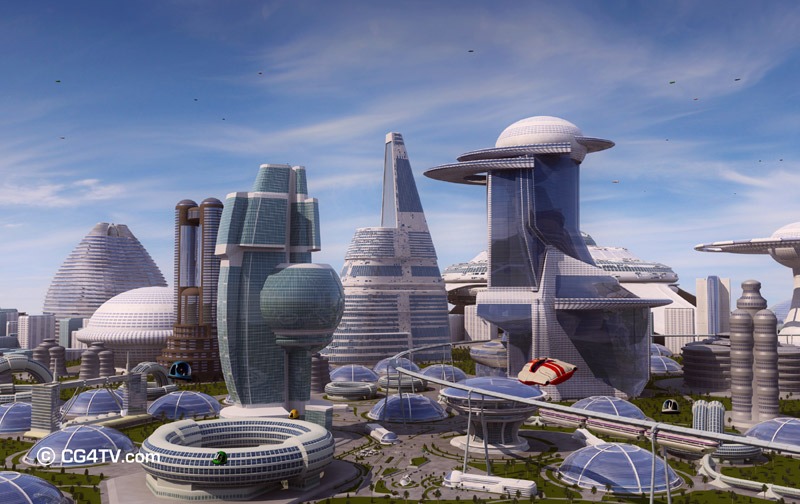
An Optimistic Forecast: Innovating our way out of Disaster

This is Part Two of a five part series on "The Future as I See for Humanity: Three Scenarios the Next Fifty to One Hundred Years." You can also read Part One: Background and Bibliography.

Given the number and magnitude of problems we are facing in the world today, any sober look at the global future is bound to produce a certain amount of anxiety. We're on the cusp of Peak Oil --Singularity and along with Peak Oil, Peak Everything since the cheap energy of oil is the glue that holds our current economic system together. We have a chronically expanding human population on its way to experimentally testing the carrying capacity of the world, and a host of environmental problems from providing for so many people.
To top it all off, our economic system is making disturbing creaking-cracking noises, and there's just not as much money to throw at problems as there used to be.

These are no longer “What kind of world are we going to pass on to our children?” questions. These are “Is there going to be a world to pass along to our children?”questions. These are “Are we witnessing the twilight of our civilization?” questions. These questions should change the way the think, the way we act, and the way we believe.

Yet oddly enough, most people seem to go about their daily business as though nothing is wrong. Are we ignorant of the daunting challenges ahead of us, or are we simply fatalists? Have we reached some kind of zen-state of detachment from these pressing issues?

Our collective mental state is guarded by two important things. First, as dire as these problems are, they are mostly invisible, and as of yet have not drastically reduced our standard of living. Second, we have a carefully cultivated faith in our capacity to produce new and better technologies that will solve any problems we run into as a society. When we hear about a new problem, most of us subconsciously write it to an anonymous team of scientists out there, whose job it is to solve the problem.

But is this faith warranted? Or are we demanding more of our systems of innovation than they can reasonably produce?

Ultimately, we don't know the answer to this question, and we can't know the answer to this question. Our technological progress is based on the independent work of thousands of thinkers, researchers, and engineers, all hoping to make creative breakthroughs that can potentially change the course of history. The outcome of such a complex, dynamic, and decentralized system is notoriously difficult to predict.

However, it is possible to outline the kinds of philosophical and practical boundaries our innovative machinery will have to overcome in solving the problems facing contemporary society. Then, assuming that our innovators can and will overcome these challenges, we can get some sense of what the technology of the future might look like, and how it might impact our culture and lives.

Philosophical Hurdles to Innovation

When we talk about innovation and new technology, we need to keep in mind that technology doesn't emerge magically in response to either investment or market forces. Nor is it an automatic, autonomous force of progress. It takes a significant investment of time, energy, and resources to move an idea into action. Nor is there any guarantee that all ideas can be acted on. Some ideas that sound quite good on paper turn out to be impractical or impossible in practice.

As population expands, nations develop and resource demands increase correspondingly, we will need new technology to more effectively use what resources we have, and we will need to discover new resources to use. This will of course create a lot of incentive for scientific research and development. But this incentive itself won't produce the technology. Research money may be mismanaged and disappear into bureaucratic machinery, there may not be enough scientists and engineers to do the work we need done, we may run into unforeseen problems in development or implementation, or we may simply fail to come up with new technology in time to solve our problems.

Though the incentive and necessity for new technology will continue to grow, there are going to be natural limits or ceilings on how quickly new technologies can be developed and deployed that no amount of external force can overcome. We can't make a baby in one month by using nine women.

Thomas Malthus explored a similar phenomenon in the early nineteenth century. He observed that, despite advances in technology, living standards seemed to remain basically constant. The reason for this, he surmised, was that population grows exponentially, while the maximum rate of increase for food production was linear. Thus, the more people, the less food to go around – even though clever new farming techniques were being continually developed.

If we are going to continue to make social and technological progress, we must somehow keep the development and propagation of problems beneath the rate at which we can create solutions. This will require an accurate sense of our development capacity, and effective manual mitigation of problems as new technology matures.

We must also keep in mind the fact that new technology does not only solve problems. It also creates them. Consider the two tons of ewaste produced annually by the United States, or food price increases driven by ethanol production. Indeed, most of the problems we are currently attempting to solve are unintended consequences of earlier technological advances.

It is counterintuitive to try to predict potential drawbacks of new technology, but as we use more and more of the earth's bounty, our margin of error gets smaller, as new problems complicate existing problems that have not yet been solved. This discipline will thus by necessity become an important part of scientific development into the future.

Practical Hurdles for Innovation

The most immediate problem for our innovators is energy creation. Our need for energy is accelerating, while our traditional sources of gathering it are reaching their maximum output. Over the next few decades, we will need massive infrastructure development in renewable power sources. Given the underdevelopment and inefficiency of much of the current generation of renewable technology, the first wave of power will likely be primarily nuclear. Down the road, however, we may replace nuclear energy with things like kitegens and space-based solar power.

We will also need to redesign our transportation infrastructure for a post-cheap oil future. Small electric vehicles are a good option, but these will place additional strain on an energy infrastructure in transition. We will also likely expand our train networks for both people moving and commercial use, and develop more public transportation options.

Of course, oil isn't the only thing we are running out of. Industrial minerals are also foreseeably finite, and energy shortage will compound the difficulties in extraction. In the short term, will need to make significant advances in recycling and resource reclamation technologies. In the long term, we will shift to using more abundant resources in all of our devices, rather than depending on rare materials..

Our food production systems will also need an overhaul. In the face of global climate change, soil depletion, water shortages, and continued population growth, new non-fossil fuel agricultural solutions will be needed in order to maintain food security. In the short term, this probably means we will be eating food that is both genetically modified and organically grown.

These challenges are daunting, but theoretically they can be solved without serious disruptions to our systems, expectations, and standard of living.

Prospects and Problems in Technotopia

Having mitigated these immediate challenges, our long-term technological future will be determined by advances in nanotechnology, biotechnology, information sciences, and cognitive science. Developments in these fields will open up interesting new dimensions for human evolution, but will pose challenging new existential and ethical questions.

When we begin to genetically modify ourselves, indefinitely extend our life span, and create direct interface between brain and computer, how will that change how we understand ourselves and the world? Are we comfortable with fundamentally and voluntarily altering what it means to be human?

Some futurists speak of the Singularity, a moment in time when we have built computers with creative intelligence that far exceed human capacities by any measure. At this point, scientific advancement will accelerate beyond anything we can currently imagine. Beyond the Singularity, it is meaningless to create any kind of forecast, as the entire meaning of history will be deeply altered.

What we are contemplating is a different kind of apocalypse. The end of humanity comes, not through death, but through our own designs, as we offer up our minds, bodies, spirits, and species to an integration into a bigger whole. We will have created a New Heavens and a New Earth. These are difficult things to wrap our minds around. But they may be in our destiny, and they may be nearer than we think.

However, our vision of the future must not distract from the tasks immediately at hand. Singularity advocates often speak in terms of human destiny, intimating that this acceleration of technological development is inevitable and already unfolding, and strangely disconnected to any of the physical realities of the earth.

While contemplating how our technologies change us and may change us in the future may be a worthy exercise, we must remember that the first problems we are going to face are the physical limitations on our resources. Our solutions to these problems are far from complete.

Wednesday, July 8, 2009

The Future I See for Humanity: Three Scenarios for the Next Fifty to One Hundred Years


Part I: Background and Bibliography

I've been thinking a lot about the future lately. Not just my own future, but -- you know -- the BIG future. Our future as a culture, as a society, as a world or species or what have you. And I must confess, not all of my thoughts have been hopeful and positive.

Obviously this flows out of my own personal context. Being fresh off the boat from a lengthy venture in India and in a prolonged period of transition has both inspired these thoughts, and defined their direction. Our current economic situation as a country has also influenced my thinking, and the recent spike in gasoline prices has certainly played a role. I said earlier that not all of my thoughts have been positive. Perhaps it would be more accurate to say that not all of them have been negative.

My angst has prompted me to comb through a vast library of material. It turns out a lot of different people are thinking about the future for a lot of different reasons, and through a lot of different media. Several compelling and well-considered opinions are out there, pointing to several different possible futures for our society. Obviously they are not all correct -- I would be surprised if any of them have more than marginal insight into what things will really be like. But they all have something to teach us if we are eager listeners and diligent students.

There are some voices of despair, and some voices of hope. Some thinkers highlight the enormous problems we are facing, others show us immense opportunities and things to look forward to. One writer has faith in God, another in humanity, another in evolution, still another in little more than his own ability to survive. Some thinkers believe that we need an active intervention to save ourselves, others think Progress and Technology will save the day; some believe that God will descend and sort everything out, others think we are simply doomed. I believe the appropriate thing to do is play these voices off of one another; to hear diverse viewpoints and bring them into harmony. Then, having developed an acceptable sense of the future, stop reading about it and live into it.

After all my reading, I feel like I do have a decent sense of where the future is headed. It's going forward. It's going to unfold. More importantly,I am personally at peace with whatever direction it goes. I can stop being anxious about it and step forward in faith. I feel more or less equipped for the adventure that lies ahead. I am ready, not only to face the future, but to contribute my talents to making it a better place.

I now want to synthesize and share the information that I have gathered. I want to enable others to glean the insights I have developed through much reading and hard work, without having to flip through thousands of pages I have pursued, or going through tremendous emotional and spiritual turmoil I have endured.

This exploration will consist of five parts. Through the remainder of this portion, I will discuss my source material, giving an annotated collection of the different ideas I am drawing on. In part two, I will outline the “optimistic” scenario for our future, in which we manage to solve all of our problems through technology without having to deal with the hardships of economic malfunction or environmental degradation.

In part three, I will examine the “doom” scenario, what could happen if we chronically fail to solve the problems that we are confronting. I will also consider the purpose and limitations of meditation on such a grim possibility. In part four, I will examine a more realistic scenario, where we solve some of our problems and fail to solve others, and so have to endure some “tough times.” And I will indulge in speculating about what toughness those times might be, and what it might require from us.

Finally, in part five, I will reflect existentially on my own encounter with futurism. I will ponder the conclusions I have drawn, and how I am currently living because of those conclusions, and what preparations I am making for living in the future I foresee. Then I will consider in general the fruits of meditation on the future as a human discipline and spiritual exercise.

I hope that these thoughts and reflections are of use. If you do not agree with me, I hope that this exploration is at very least interesting, and provokes additional reflection and conversation. Above all, if you are currently trapped under anxious thoughts about our common future, I hope that this series will help liberate you from that burden, or at very least point a way out.

I do not know what the outcome will be of releasing these thoughts into the wild, but I do so in faith, dedicating my words to the Triune God, my own rock and ballast against despair, and my poor wife, who has sat through innumerable lectures on the inevitable doom of humanity through the adolescence of my thoughts on this matter.

A Bibliography of Futurism

I was first formally alerted to the aesthetic and environmental poverty of American suburbia a couple of years ago, when I read James Howard Kunstler's Geography of Nowhere. Kunstler has written several other books I have not read, including a popular novel on a post-apocalyptic world entitled World made by Hand. I have not read any of his other material, but feel generally acquainted with his thinking through Geography of Nowhere, a few interviews, and his blog.

The alarmist website Life after the Oil Crash first showed me exactly how dependent our society is on cheap fossil fuels. I have done “what if oil ran out tomorrow” thought-experiments since the college cafeteria, but LATOC finally gave those thoughts some muscle – and fear.

Dimitry Orlov makes for an enjoyable (if somewhat frightening) read, either at his blog, through one of his articles floating on survivalist sites, or his book, Reinventing Collapse. He is a Russian American who had the opportunity to witness some of the Soviet collapse and sees America on a similar trajectory. Besides developing his “comparative theory of superpower collapse,” he give snippets of what a post-collapse America might look like, and outlines broad survival strategies. And he does it all with a dark sense of humor that makes his grim prophecies surprisingly entertaining.

Internet Monk's three-part series on the Coming Collapse of Evangelical Christianity in America has been well-talked about in Christian circles, and has provided interesting counterpoint to my own thinking. I agree with his thesis, but would go on to say that contemporary American Evangelicalism is having a hard time that strongly mirrors our cultural struggles. In our context, religion has a powerful opportunity to speak prophetically and call people to a better, more integrated way of living. It grieves me that we are missing that chance.

Geopolitical forecaster George Friedman wrote an interesting little book that I polished off earlier this summer entitled The Next 100 Years. He has a pretty positive view of the future. My only complaint is that he interprets the next hundred years unfolding with very similar surprises to those we saw in the past hundred years. I think the next hundred years has very different surprises in store.

I try to stay on top of what techno-futurists like Ray Kurzweil are saying, even though I think that he is crazy. Still, there is no denying that he is a bold visionary – and since none of his predictions violate the laws of physics, they are at least physically possible.

The Long Now Foundation's seminars on long-term thinking (ie 10000 years out) are fascinating. They have provided me with many interesting things to think about, and acquainted me with several of the authors and works listed here.

Recently, there has been a rash of television shows about the future, like Earth 2100 and Aftermath. All of them are pretty doomy, but interesting if you can take your doom. I've seen snippets of several, but I've spent most of my time with “Life after People.” It is fascinating (and strangely cathartic) to watch dramatizations of the earth chugging on without us, and see computer animations of our accomplishments crumbling into nothing. You can watch the first episode on Google Videos.

I just finished Jared Diamond's excellent (though lengthy) Collapse, which details the collapse of several societies around the world, gives reasons for their decline, and extracts lessons that we can learn today. Diamond relies heavily on Joseph Tainter's Collapse of Complex Societies, which I haven't read but have heard is worth consideration for serious students of the topic.

These days, I'm following The Oil Drum blog, which gives a daily roundup of energy/future headlines, and an occasional thought-provoking article. It also connected me with this (link) titillating talk on the mathematics of phase transitions and how that applies to the life-cycle of societies.

I've been reading a number of anarchist / libertarian materials, and appreciate their contribution, imagination, and experimentation in thinking of a different way to live and run society. I am attracted to Freeganism in particular, as a prophetic way of living at this moment against consumer culture. I am working to adopt some Freegan practices into my own life.

I really like the work of the Transition Towns movement. They take the doom of peak oil and global warming and make it into something positive, doing hands-on work in preparing communities for energy descent. Similarly, Michael Pollen, author of Omnivore's Dilemma, manages to stay positive and up beat, even though he is very sensitive to the dangers of environmental degradation and acutely aware of dire the problems emerging in our food cultivation systems.

I've enjoyed getting some different points of view from the Peak Oil Debunked blog, particularly this article, Confessions of an Ex-Doomer. This article helped me push past my latent doomer outlook and start aiming at something more positive and more constructive.

I've also been impacted recently by “emergence thinking” in a variety of fields. Religion, social theory, and biology are all experimenting with networks and emergence as mechanisms for everything from social change and biological evolution. If we're going to solve our problems, I think that emergence will also serve as the mechanism thorough which those solutions appear. (And I as a Christian find emergence to be a hidden form of grace.) Unfortunately (or perhaps appropriately, given the nature of the subject) I cannot remember where, exactly, I have encountered this material most succinctly.

Similarly, I have taken quite a bit from my small participation in the emerging “free culture” on the internet: from switching over to Ubuntu linux to contributing a word or two on Wikipedia. Currently, free culture is limited by our current resource-intensive capitalism. But I think models are developing within free culture projects that will be become incredibly important in the next age, if not the next few decades.

Finally, I would like to read Gunderson and Holling's Panarchy: Understanding Transformations in Human and Natural Systems. From what I've encountered of the book, I think it would contribute significantly to the thinking that I have already developed, and resonate with some of the spiritual conclusions I have drawn in pondering the future.